One approach, whoever your family sees. Child-led, attachment-focused, connection before correction.
Your Therapy Nook is a group practice led by founder Hannah Ly, LMFT, alongside the therapists she hires, trains, and clinically directs. Children and teens are the whole practice, and every therapist here was hired because child and teen therapy is their whole focus.

Founder & Clinical Director
The free 15-minute call is with Hannah herself.
I'm Hannah, the founder and clinical director. I've been working with kids since 2012, and every therapist on this page learned to work the way I do: behavior is communication, and connection comes before correction.
I came to this work by way of nannying, which taught me how much of a child's day happens between pickup and bedtime.
The parents I worked for loved their kids and tried hard. Nobody was helping them understand what their kids were saying, and that's the part I do now.
Play therapy is the core of what I do, and it's what this practice was built around. With younger kids, I let the child lead. They pick what we do, and I pay very close attention to what they're telling me while they do it.
The same figures chosen every week, the story that gets started and abandoned, the glance over to check I'm still there. My main job is to see, and then to help you see it too.
With teens, it's drawing, games, and real conversation. I get curious about the person before anything clinical. And when something is sitting in the body that talking can't reach (the test panic, the thing that happened that they won't go near), I use Brainspotting.
With parents, we meet every four weeks, in every case. You're the expert on your child. I bring what I'm seeing in the room, and we work out together what it means for home, because the therapy doesn't go far if nothing changes there.
Warm, gentle, and playful is how the people closest to me describe me, and it's what your child gets in the room.
I train our therapists myself and review every case weekly. Whoever your family sees here, you're getting the same approach, held to the same standard. Every therapist on this team is here because children and teens are their whole focus, not one population on a list.
• Licensed Marriage and Family Therapist, LMFT #129711, California BBS
• Master's Degree in Counseling, Western Seminary
• Synergetic Play Therapy, advanced training
• Brainspotting Phase 1, Pacific Trauma Center, including Brainspotting for Children
• Advanced LGBTQ+ competency and treatment training, Santa Clara County
• Adoption-competent, attachment-focused clinical training
• Working with children and families since 2012
Read Hannah's full story
Licensed Therapist
Hannah does every first call. Ask for Sabrina by name.
I work with children and teens. A lot of the kids I see are the angry ones. The one who slams the door, throws the controller, says the thing they can't take back. The one whose teacher has started emailing. I also see the quiet ones, the kids adults call shy or read as fine, who are often carrying the most. And I see the teens who did not ask to be here and would like that noted.
Anger is the feeling adults usually misread. People react to what comes out and skip past what's underneath it, which is usually hurt, or fear, or the exhaustion of having no good options and every adult already decided who you are. Kids who've spent a while being treated as the problem don't hand that over on the first visit, and I don't ask them to.
I don't open with feelings questions. Sometimes we start with a deck of Uno cards: pull a color, tell me what went with it this week. Sometimes we talk while doing something else, drawing or a game, because facing an adult who wants you to open up on command is the hardest way to do this. With younger kids that something else is usually play. With teens it's usually a real conversation, and I'm trained in motivational interviewing, which is a formal way of saying I can sit with someone who isn't sure they want to be here without pushing. A session is going well when a kid feels safe enough to try something, even something hard.
Older kids need to know what stays in the room. Before each parent session I ask what they want shared and what they'd rather I hold, and unless safety is involved, I honor that. You'll still know how it's going. You won't get a transcript.
Early on I'm after connection, not progress, so your child may leave the first few sessions unsure about all of this. That isn't a bad sign. Most of what shifts happens at home between sessions, which is why I'll want you in this with me. Spanish-speaking families: sessions and parent coaching are available fully in Spanish, and a kid who lives in two languages can switch whenever the feeling does.
Outside of work I'm in the garden, or off finding somewhere new with my kid. Kids usually spot the Bratz charm on my bag first.
• BA in Psychology, minor in Child and Adolescent Development, San José State University
• MA in Counseling Psychology, University of San Francisco
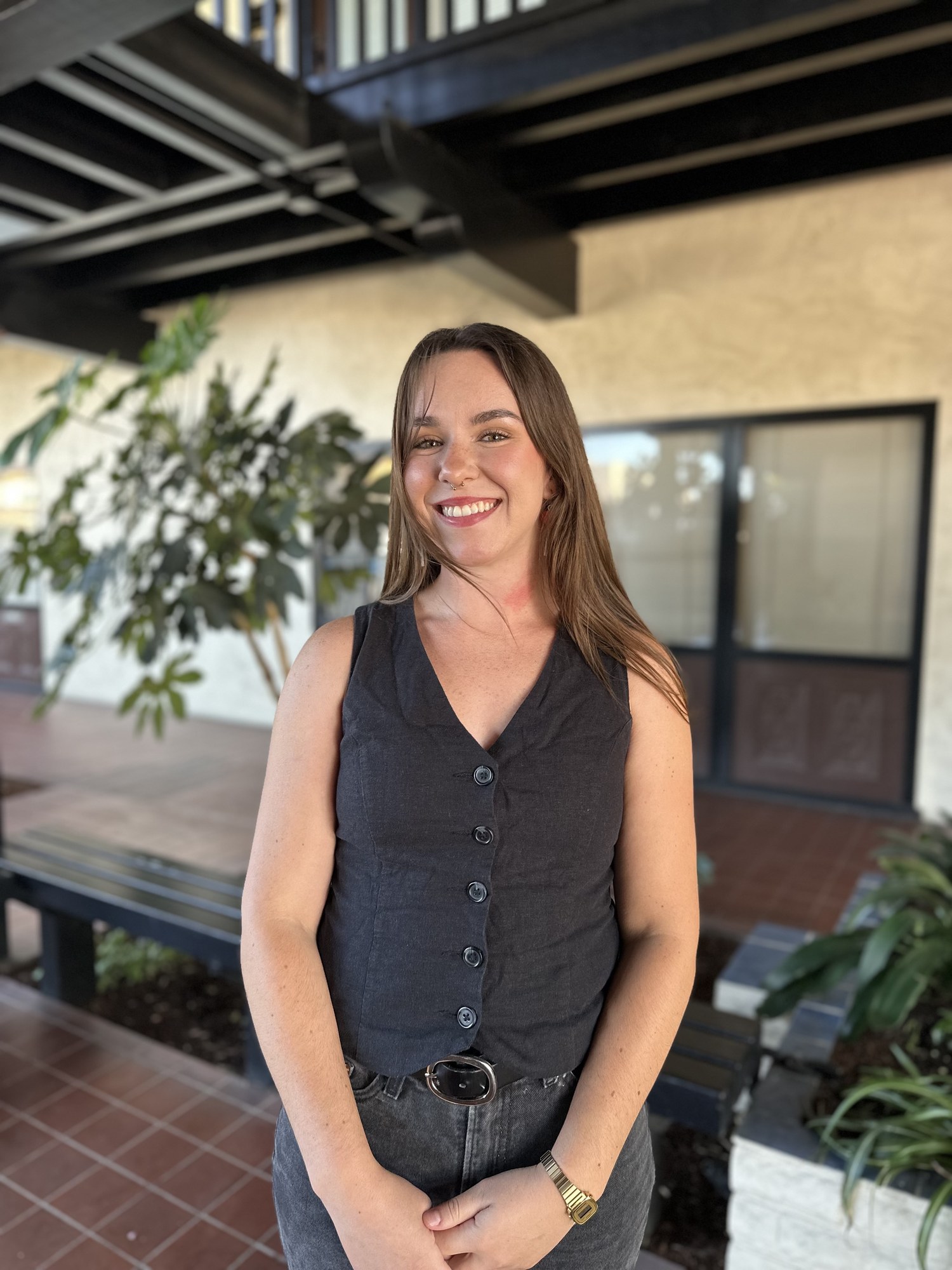
Associate Therapist
Hannah does every first call. Ask for Bailey by name.
I work with young children, and three to six is my favorite age to sit with. A lot of the kids I see are too little to say what's wrong, so it comes out sideways. The three year old who detonates over the wrong cup. The five year old sent home from preschool twice this month.
Autistic kids have been part of my work since before I was a therapist, first as a childcare provider and an aide, then at a children's trauma program in Kansas City where about one in five of the kids I saw were on the spectrum. I've trained in adapting play therapy for them, because what helps a child process trauma has to be rebuilt for a nervous system wired its own way.
A tantrum isn't defiance. It's a child who ran out of options before they ran out of feeling. Three to six is the age adults misread most.
At a first session I'll come out to you rather than ask a child into a room they've never seen. I'll bring a toy into the waiting area and sit down there with both of you. Nobody has to leave a parent on day one.
A session is going well when a child is playing something out. Kids brush my hair, hand me a figure and cast me as the bad guy, change the rules halfway through. When a body needs to come back down it's usually sand or water.
Early on I'm not looking for a breakthrough. Your child is the one working things out through play. What I do is make the room safe enough and the hour slow enough that they can, and help you see what they're showing you.
Weekends are thrift stores, coffee, and outdoors as much as I can manage.
• BSW, University of Kansas
• MSW, University of Kansas
Every therapist here has a master's degree and is registered with the California Board of Behavioral Sciences, and every profile lists the exact credential. Titles tell you where someone is on the path.
Associate Therapist
Licensed-track, earlier in the supervised hours California requires
Registered Associate MFT, CSW, or PCC, with registration number
Senior Associate Therapist
Hours complete or nearly so, preparing for the licensing exam
Registered Associate MFT, CSW, or PCC, with registration number
Licensed Therapist
Fully licensed
Licensed MFT, CSW, or PCC, with license number
Founder & Clinical Director
Fully licensed; supervises every therapist and every case
LMFT #129711
Every therapist, at every level, works under Hannah's weekly supervision, practices the same approach, and was hired to the same bar. Hannah is glad to walk through any of this on the consultation call.
Hannah Ly, Licensed Marriage and Family TherapistFounder & Clinical Director
$300 / 50 min
San Jose + Redwood City
Sabrina Yglesias, Licensed Marriage and Family TherapistLicensed Therapist
$250 / 50 min
San Jose
Bailey Verhulst, Registered Associate Clinical Social WorkerAssociate Therapist
$200 / 50 min
San Jose + Redwood City
Private pay only. We don't bill insurance, and we provide superbills for out-of-network reimbursement.
Consultations outside of a regular session (a school meeting, a call with your child's psychiatrist or pediatrician, a longer phone call between sessions) are billed at your therapist's session rate, prorated for the time used. So a 30-minute call at a $200 session fee is $100. The first 15-minute phone consultation is always free.
Rates and fees2901 Moorpark Ave, Suite 270, San Jose, CA 95128
Hannah, Sabrina, and BaileySaturday and Sunday appointments available
Details & Directions611 Veterans Blvd, Suite 210, Redwood City, CA 94063
Hannah and BaileyAfter-school appointments available
Details & DirectionsYes. Child-led play therapy, attachment-focused, with parent coaching every four weeks in every case. Hannah trains every therapist here herself and reviews cases weekly, so the approach holds whoever your family sees.
Yes. An associate has a master's degree, is registered with the California Board of Behavioral Sciences, and works here under Hannah's direct weekly supervision. A licensed-track therapist, not a student. The rate difference reflects licensing status, not the standard of care.
That's what the free consultation is for. Most families do well with any of us, and we all work the same way. See Hannah if you want the founder herself, or if what's going on is complicated. See another therapist on our team if you want to start sooner or if the fee matters to your family. You can always request a specific therapist.
Yes. Sabrina Yglesias provides therapy for children and teens in Spanish or English at our San Jose office, and parent coaching is available fully in Spanish.
The consultation call is with Hannah, and that is by design. The other therapists on our team don't run consultations; their job is the therapy in the room with your child. Hannah runs every consultation because she's the clinical director and matching a family with the right therapist is her call to make. If you're interested in a specific therapist, say so on the call. Hannah trained them and reviews their cases weekly, so she can tell you exactly how they work, who they click with, and whether they're the right match for your child.
Yes. Her availability is more limited and her waitlist moves slower, and we'll be straight with you about the timeline on the call.
Tell us. Fit matters more than loyalty to a first choice, and moving your child between our therapists is simple. If we're not the right practice at all, we'll help you find one that is.
Why specialization matters, questions to ask, red flags, and how to tell when you have found the right fit.
A play therapist explains why sessions look like ordinary play, what is actually happening in the room, and what change tends to look like over time.
Why children ages 3 to 10 work things out through play, and how to tell whether it fits your child.
The consultation call is free, 15 minutes, and with Hannah. We'll talk about your child, answer your questions, and match your family with the therapist on our team we think fits your child best, usually one of our other therapists, each trained and supervised by Hannah.
Book a Free 15-Minute Consultation