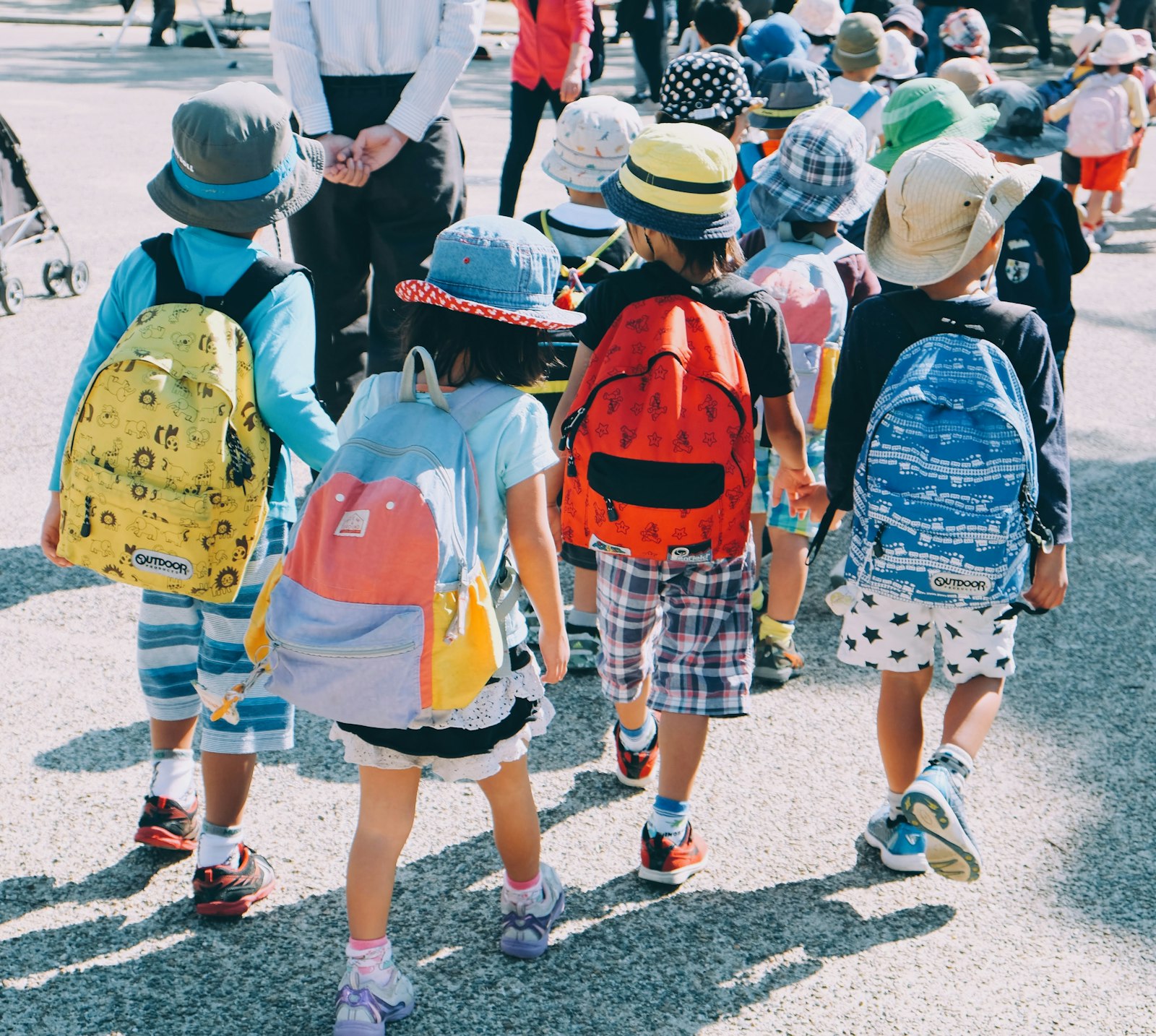
You know the sound. You can hear it from the parking lot.
It's the third week of school and it's still happening. Not a sniffle. The whole thing. Both arms locked around your neck, please, please don't go, a teacher you barely know gently working their fingers loose while you say "you're okay, you're okay" in a voice that doesn't sound like yours. You walk away because everyone says you're supposed to walk away. You can hear your name the whole way to the car.
Then you sit there. Engine off. You're already late for the 9:00 and you can't make yourself drive. You're wondering if you just did the right thing or the worst thing, whether the other parents saw, and why their kids hop out of the car and jog in like it's nothing. Their kids are fine. Their kids are in the Mandarin program and doing great. Yours is on the other side of that door, and you can still hear it.
You'll do it again tomorrow. You already know that. You've started waking up at 5 with your stomach in a knot about a goodbye that's three hours away, and you've started wondering, quietly, whether this is the beginning of something. Whether a kid who can't get out of the car in kindergarten is going to be okay.
If that's your morning, I want you to know two things. A kid who cries at drop-off is not a kid who's falling behind; it's a kid with a healthy attachment system and a new room. And crying at drop-off is one of the most common reasons families call us in September, from every school in the valley, including the ones everyone's trying to get into. It also has a plan, a real one, for the sixty seconds at the door that decide how the rest goes. Here's what's actually happening in your child's body, what to do at the car door tomorrow, and how to tell when it's more than a rough start.
I'm Hannah Ly, LMFT, a child therapist in San Jose and Redwood City and the founder of Your Therapy Nook. Separation is something I work with every week, because a small version of it happens at my playroom door every single session: a child has to let go of a parent's hand and walk into a room with someone new. I do play therapy with the child, where they get to play out the goodbye until their body believes it's survivable, and parent coaching with you, so the sixty seconds at the school door get a plan. This post is that plan.
Is crying at school drop-off normal?
Yes, especially in the first few weeks and especially for preschool, TK, and kindergarten. Crying at drop-off is a healthy attachment system doing exactly what it's built to do: protest being separated from the person who keeps you safe. Most kids stop within two to four weeks once the classroom becomes familiar and they've found one person or one thing they like there.
Two things worth knowing right away. First, the crying usually stops within a few minutes of you leaving, even when it's dramatic at the door (ask the teacher; they'll tell you). Second, how long it lasts has a lot to do with what happens in the sixty seconds before you leave, which is the part you can change.
Why does my child cry at drop-off?
A challenge our brains commonly perceive is our lack of understanding about the unknown. When a child doesn't know what the day will look like, who will be there, or what happens next, their brain fills in the blanks, and for children the blanks can feel really scary. Drop-off is the moment the blank starts and the safe person leaves. So the body protests.
Their nervous system gives one of two answers. "I can do something about this" is the clinging, the crying, the refusing to get out of the car, the negotiating for one more minute. "I can't do something about this" is the kid who goes quiet, walks in with a flat face, and then has a stomachache at 10am or falls apart at pickup. It's the same fear of the unknown in both children, and the quiet version is the one that gets missed, because from the outside it looks like a kid who's doing fine.
I invite you to get curious about which one your child is doing, because the plan below works for both, but you'll notice different things getting better.

How to handle crying at school drop-off: 7 steps
1. Fill in the blanks the night before. Walk through tomorrow in order: "First you'll hang up your backpack. Then you'll sit on the rug. Then centers, then snack, then recess. Then I'll be at the bench." Ask the teacher for the real schedule and read it together. A brain that knows what's next doesn't have to invent it.
2. Pick one goodbye ritual and do it exactly the same way every day. Two squeezes and "see you at the bench." A high five, a hug, a secret word. It doesn't matter what it is. It matters that it's identical, short, and happens even on the good days. The ritual becomes the thing their body recognizes as "this is how it goes, and it's okay."
3. Keep the goodbye under a minute. This one is a gift to you too, on the mornings you have a 9:00. A long goodbye tells a child's body that this separation is dangerous enough to need a long goodbye. Say the ritual, say "I love you, I'll be back," and go. Lingering, coming back for one more hug, or hovering at the window all extend the hardest sixty seconds of their day.
4. Validate the feeling, then leave anyway. "You don't want me to go. That feels really hard right now. I know. Ms. Chen is going to help you, and I'll be at the bench at 2:30." You are not saying school is optional, you are saying the feeling is real and you're still going, and a child can hold both of those at the same time even when it doesn't look like it.
5. Give them a job for the first two minutes. The hardest part is the moment after you walk away. Set up what happens next: "When I leave, you're going to put your lunchbox in the bin and then find the blue mat." A concrete task gives their body somewhere to go besides the door.
6. Hand them off to a specific adult, not to the classroom. Ask the teacher or aide to meet you at the door and take your child's hand, or put a hand on their shoulder. Kids separate better from a person than from a room. If the school can't do that every day, ask for it for the first two weeks.
7. Do a slow warm-up on a quiet day if you can. Walk the route to the classroom on an afternoon. Sit on the pickup bench for ten minutes before the bell so they watch how it goes. Find the bathroom. Say hi to the teacher for thirty seconds with no pressure to talk. Slower, more controlled exposure to the new thing helps their brain take in concrete information and experiences and replace the fear of the unknown with something tangible about what's coming. It is a lot slower than a pep talk, and it does work.
What not to do at drop-off
- Don't sneak out. It feels kinder in the moment. It teaches them you might disappear when they look away, and tomorrow's grip gets tighter.
- Don't say "you're fine" or "big kids don't cry." Their body is telling them otherwise, and now they've learned you can't hear it.
- Don't bribe. "If you don't cry I'll get you a treat" makes the crying the point of the transaction.
- Don't ask "do you want to go in?" They don't. Don't offer a choice you can't honor. Offer a choice you can: "Do you want to walk in or should I carry you to the door?"
- Don't do the goodbye twice. Once you've left, you've left.
Crying at drop-off by age
Preschool and TK (ages 3 to 4): expect it. Keep words very short, because a flooded three-year-old can't take in a paragraph. Put the plan in objects: a photo of you in their cubby, something small from home in the backpack pocket, the teacher's picture on the fridge at home.
Kindergarten and first grade (ages 5 to 7): the ritual matters most here. They're old enough to hold "two squeezes and see you at the bench" and to be comforted by it. Ask what the specific worry is; at this age it's often one thing (the bathroom, lunch, one kid).
Second grade and up (ages 7 to 10): crying at drop-off is less common and more likely to have a specific cause: a friendship that shifted over the summer, a hard teacher, something that happened at recess. Chase the why. If they can't name it, that's what play therapy is for.
How long does drop-off crying last?
Two to four weeks is typical. Some kids need two weeks of the identical ritual before their body believes it. Some need a month. If you're five or six weeks in and it's the same or worse, or if it started fine and then got hard, that's information worth acting on.
When to see a child therapist for drop-off crying
Some kids need more than a ritual and a bench. A hard first month is not a reason to call a therapist. A second month that looks like the first is. I'd pay closer attention if:
- the crying is still intense five or six weeks in, or has started getting worse
- your child is refusing to go and some mornings you can't get them there
- the fear has moved into the body: stomachaches, headaches, trouble sleeping, holding their bladder all day
- the worry follows you outside school too: bedtime, babysitters, you leaving the room
- they're saying things about themselves ("I'm a baby," "I can't do it") rather than about school
- you're so dreading mornings that you've started avoiding the subject entirely
None of that means you did something wrong. It means the challenge is bigger than what a tip on a blog can hold, and you don't have to be sure it's serious before you call. Most parents who contact us in September aren't sure; figuring that out together is what the first call is for.
What child therapy for separation anxiety looks like
It starts with a free 15-minute call with me, no intake forms, where I listen, ask about your kid, and tell you honestly whether we're the right fit. Separation anxiety and school anxiety are among the most common reasons families call Your Therapy Nook.
The first session is the opposite of drop-off. You come in together, and for a young child you're often in the playroom too. Your kid can stay glued to your leg as long as they need to; nobody peels them off. In play therapy, a child gets to play out the scary classroom and the goodbye, with a child therapist who follows their lead, and practice being regulated inside the fear instead of alone in it. Over time, the goodbye at our door becomes practice for the goodbye at the school door.
You're part of it. Through monthly parent coaching, you get someone to think through the drop-off line with, and a plain-language translation of what your child is showing us in the room.
What I can't promise is a timeline. Some children need a few sessions just to decide the room is safe, and that's normal and expected. What I can tell you is that separation is something play therapy is particularly good at, because a version of it happens at the playroom door every single week, with someone there whose job is to help it go well.
The bigger picture on why kids fall apart in September is in is my child's back to school anxiety normal?
School drop-off FAQ
Should I stay until my child stops crying? No. Staying extends the hardest part. Do the ritual, validate the feeling, hand off to an adult, and go. Ask the teacher to text you if it lasts more than ten minutes; it almost never does.
Is it okay to let my child skip school if drop-off is too hard? As a one-off after something big, maybe. As a pattern, no. Every avoided morning teaches the brain that avoiding worked, and the next morning is harder. Shorter goodbyes and a specific plan work better than a day off.
My child was fine for two weeks and now cries at drop-off. Why? This is common. The novelty wore off and the reality set in, or something specific happened (a kid, a substitute, a hard moment at recess). Ask about the specific moment, not the day. If nothing surfaces, watch for the quiet signs listed above.
Talk to a child therapist in San Jose or Redwood City about separation anxiety
If the goodbyes aren't getting easier and you're out of pep talks, I'd be glad to think it through with you. It starts with a free 15-minute phone call with me, there's nothing to fill out first, and by the end of it you'll know whether we're the right fit or whether I'd point you somewhere else. If we are, your child sees one of the child and play therapists on our team: me, Sabrina Yglesias at our San Jose office (English and Spanish), or Bailey Verhulst in San Jose and at our Redwood City office, for Peninsula families in Redwood City, Menlo Park, and Palo Alto. All of us practice the same way, and separation at the playroom door is something every one of us handles every week.
Schedule a Free 15-Minute Consultation
About the Author, Hannah Ly - San Jose Child Therapist
Hannah Ly is a Licensed Marriage and Family Therapist (LMFT #129711) and the founder and clinical director of Your Therapy Nook, a boutique child and teen therapy practice with offices in San Jose and Redwood City, CA. She is a child therapist, play therapist, and teen therapist, trained in Synergetic Play Therapy and Brainspotting, with a long background in adoption and foster care. Hannah does every family's first call herself, and every therapist on the team practices the way she does. Every family gets child-led play therapy or teen therapy plus parent coaching every four weeks.
Learn more About Hannah